

6 Jan 2025
Post by Midwest Money Mentor
Holy-moly, you are a home owner! I hope you are as excited as I am after any of my property purchases. I usually have a huge desire to be able to start making the property my own (or make improvements).
As you progress down the road from your initial euphoria, one of major components of owning the property (outside of making your payments, doing upkeep, and other steps) will be the process of paying your homeowner’s insurance and property tax costs, each year.
For some people, you will pay your own property taxes and homeowner’s insurance costs as they come due. This is because you either did not set up an escrow account with your mortgage, or you paid cash for the property (and no mortgage was needed or escrow set up).
For everyone else, you are either required to have an escrow account because you used a program that requires it (FHA, VA, Rural Development) or you elected to have an escrow account even though you put down 20% or more (with a conventional loans).
So, let’s go through what your escrow account is, what it is going to do for you, and what you will need to be involved in going forward.
What is an escrow account? An escrow account (sometimes called an impound account in different areas) is an account that is established by your mortgage lender, on your behalf, with your mortgage. It’s purpose is to pay certain property-related expenses (like homeowner’s insurance, mortgage insurance, and property taxes) for you as they come due. The theory is that this account can make it easier for the average person to pay large bills (your property taxes and homeowner’s insurance both may be thousands of dollars a year) and decrease the likelihood that many people could get behind on their financial obligations (hopefully also helping to avoid the possibility of foreclosure).
With your mortgage having an escrow account, you pay one payment each month, that encompasses partial payments for your upcoming tax and insurance bills. The servicer of the mortgage then separates out your combined payment into accounts that then pay your individual costs (principle, interest, mortgage insurance, taxes, homeowner’s insurance, etc.). You do not have to worry about the tax, mortgage insurance, and homeowner’s insurance payments being made, and the lender and servicer do not have to worry about you being as likely to get behind on these pieces.
How is the payment to escrow calculated? It is fairly simple, you take all the combined expenses you have outside of your principle and interest payment, add them together and divide by 12 months. So, let’s say you have annual property taxes that equals $3000, annual homeowner’s insurance that equals $1800, and annual mortgage insurance that equals $1200. That would equal a combined cost of $6000 a year. Your escrow portion of your monthly payment would then be $500 (which is $6000 divided by 12 months). This $500 (in this example) is added on top of your principle and interest payment for your total payment.
Just remember though, that your property taxes and your homeowner’s insurance costs will change every year with the county adjusting your tax assessed value on your home and your insurance company adjusting your homeowner’s insurance costs. This means your monthly mortgage payment will go up or down each year, depending on the cost changes you have.
On to an Escrow Analysis. So, if your taxes and homeowner’s insurance costs change every year, how does the mortgage servicer know of the changes? Enter the Escrow Analysis.
Once a year, your mortgage servicer will conduct an analysis of your escrow account balance and compare that to the new costs of your homeowner’s insurance premiums and property taxes. Two things will happen:
- Once the servicer knows the new costs of your insurance and taxes, they will adjust your monthly payment in the same format we discussed above (taking your homeowner’s insurance annual costs, property tax annual costs, and mortgage insurance annual costs and dividing it by 12 months, and then adding that 12 month payment on top of your principle and interest payment for your total payment).
- You will have a Shortage or an Overage of money in your escrow account. Once the new numbers are calculated, the servicer will know if you have enough money in your escrow account to pay for the updated costs, plus a small buffer that the government traditionally requires in the account (The “Cushion”).
- If their is a “shortage”, meaning there is not enough money in the account because the tax and insurance costs increased a good amount, you will be notified of the shortage and asked how you would like to cover the amount. Your first option would be you could pay the shortage over time (in essence you would take the amount the account is short, divide it by 12 months, and add that payment to your updated mortgage payment (which already includes taxes, insurance, mortgage insurance, principle and interest). Your payment would increase more but you would have no out of pocket costs. Your second option is to just pay the shortage in full through your online payment website or through calling the servicer. Your payment does not go up more but you pay out of pocket. Your choice, based on what fits you best.
- If their is an “overage”, that means the account has a surplus above what is needed and above what is needed for the cushion. In this scenario, the servicer has to send you any funds that are being held above the amount needed in the escrow account, plus the cushion. Within 30 days of the analysis, you will receive the excess funds to do with as you please, and your payment will decrease based on the new insurance and tax costs.
What if I don’t have an escrow account, and I want one? Or what if I have an escrow account, but I want it removed? Well, both are fine, under certain circumstances.
The simplest option is to add an escrow account. If your mortgage does not have one already, and you wish to add one, you simply need to write or fax a letter to your servicer asking to have an escrow account added. You would want to indicate if you want the escrow account to collect for taxes, insurance, or both. And you will want to provide the servicer with your current property tax and homeowner’s insurance bill (along with proof that both taxes and insurance are paid up to date).
To remove an escrow account, you have to get permission from the loan’s servicer and investor. On top of that, you have to have many other factors, like:
- Your loan is not an FHA/Rural Development loan. Those programs do not allow escrow to be removed.
- The payments cannot be past due, your loan could not have been previously modified due to payment issues, and you cannot have force-placed insurance because your insurance lapsed.
- You cannot be in a special flood hazard area.
- You cannot still be paying private mortgage insurance or have less than 20% equity in the property.
- And more scenarios as required by the servicer and investor.
To wrap up this post, an escrow account is pretty simple. It helps you pay your taxes, insurance, mortgage insurance, and other property-related costs on time. As with anything mortgage related, there are many scenarios that come up. So, if you have questions about your payment changes, shortages or overages, or anything else related to your payment and escrow, make sure to reach out to your customer service team with your mortgage servicer.
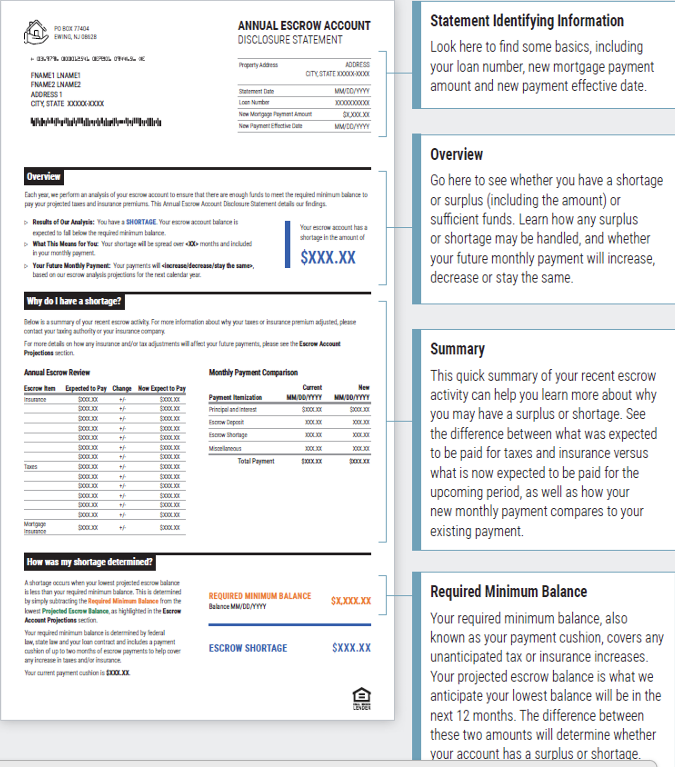
For a few more helpful notes on reading your upcoming escrow statements, see this nice guide below (courtesy of CMG Mortgage/CMG Financial/CMG Mortgage Servicing Operations).

And, because why not, let’s give you a random picture from the Ocean Art Contest as a send off to the rest of your reading –


0 Comments