

20 Jan 2025
Post by Midwest Money Mentor
One of the more intimidating parts of buying a home is making an offer on a property. There is a lot that goes into deciding on the offer and a lot more you should make sure you understand to protect yourself in the process.
Though, if you work with a real estate agent, much of this should get reviewed with you while you are making the offer (by the agent), it is still best to make sure you are comfortable with what a purchase agreement looks like and what everything on the agreement means. This is especially true with a home purchase (compared to vehicle, or something smaller) so you don’t lock yourself into a multiple-hundred thousand dollar buy, blindly.
So, let us do just that. I’m going to put a purchase agreement (for my area of South Dakota) on this post and go through the main pieces of the agreement with you. Depending on where you live, your area’s residential real estate purchase contract may look different than this one, but the main points will be largely the same.
To begin, here is page 1 of our local area contract (as of January 2025). Take a quick look over it’s outlined information.

We will start at the top and go down, to keep this sucker simple.
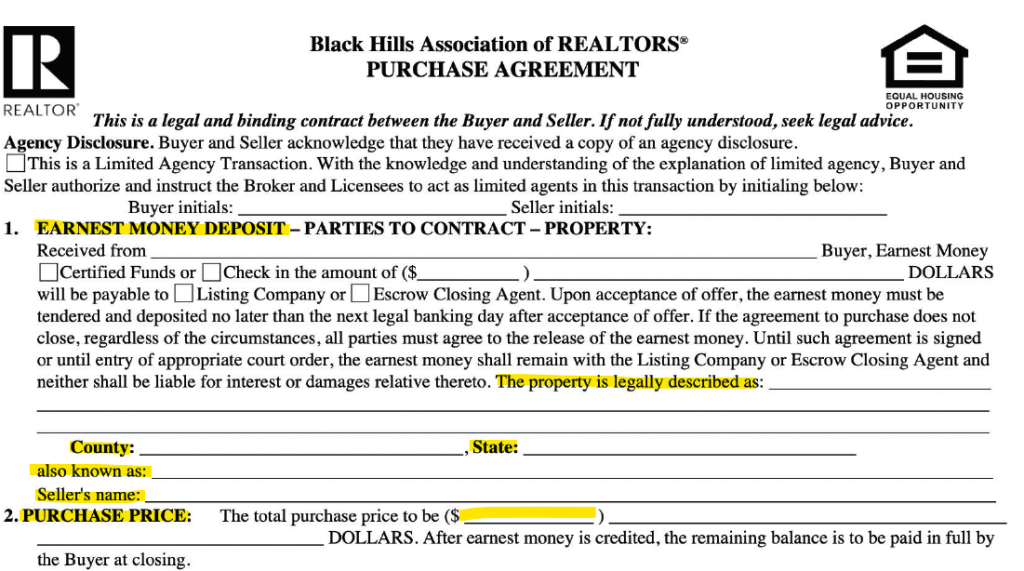
There are many notes to make within any purchase agreement, but I am going to pick out the important ones and skip the rest to not have this post turn into a hundred page novel.
Here are the big pieces:
- You should note at the top, even though it is not highlighted, this contract (and any purchase agreement) is a legal and binding contract. That means, if you make an offer on a property and pull out of the offer for any reason not outlined further down in the agreement, you could get sued by the seller and forced to purchase the property. Do not make offers on properties lightly. If you do have a good reason, as outlined by contingencies further in the agreement, you should likely have nothing to worry about.
- Do people actually get sued for breaking a purchase agreement? All the time. Would you? Possibly not, but you need to come into the offer understanding that you are signing a binding contract and are expected to purchase the home unless specific events allowed you to withdraw.
- See number 1 on the contract – Earnest Money. Earnest Money is good faith money. Though earnest money is technically not required for you to go under contract and purchase a property, there are very few scenarios in which the seller would not require or expect you to put Earnest Money down.
- In essence, earnest money is money you give to the seller once you are officially under contract on the property. It acts as a down payment/deposit of sorts, and gives the seller some comfort in accepting your offer because if you try to pull out of the contract for no good reason, the seller can keep the money to reimburse their time and costs, to some extent.
- Normally, in this specific market, it is customary to provide $1000 of earnest money to the seller with your contract. Other areas will be different, and just because one amount is customary does not mean that is the amount you must do. Lower dollar figures may be fine, or higher dollar figures may be expected, depending on situation.
- If you, the buyer, close on the purchase of the home, this earnest money deposit acts as part of the money for your down payment and closing costs. That is because it is a cost you already put into the transaction. So, the funds are not extra expenses you pay on top of your other costs. Also, if you pull out of the offer for a reason detailed on the rest of the purchase agreement, you likely will get this money back from the seller. Again, if you pull out for a reason other than outlined, you could lose these funds (and possibly get sued).
- When your offer gets accepted, normally you (the buyer) would make the check out to seller’s real estate agent’s office, or the closing company. They will hold this money aside in an escrow account until the transaction closes or gets canceled.
- The Property Description – I’m sure you can figure out that in order to purchase the property, the purchase contract has to outline the property address and property description, so the correct property is purchased and the transaction is documented correctly. As you can see on the purchase agreement above, this means you should outline both the property address (where it says “also known as”) and the property’s legal description which you can obtain from the county or the county’s website. Also noted is the property seller’s name, for more verification and clarification.
- The Purchase Price – This should be pretty clear, this is where you write out the price you are willing to pay for the property in both numerical and written form. For instance – $400,000.00 and then Four Hundred Thousand Dollars and No Cents.
- Just a reminder, this is the price you are offering to pay. You need to make sure that if they accept the offer, you are ready to pay that amount. If the seller does not agree to the amount you offer, they can counter to a different price (along with countering anything else you propose on the offer).
Next Sections:
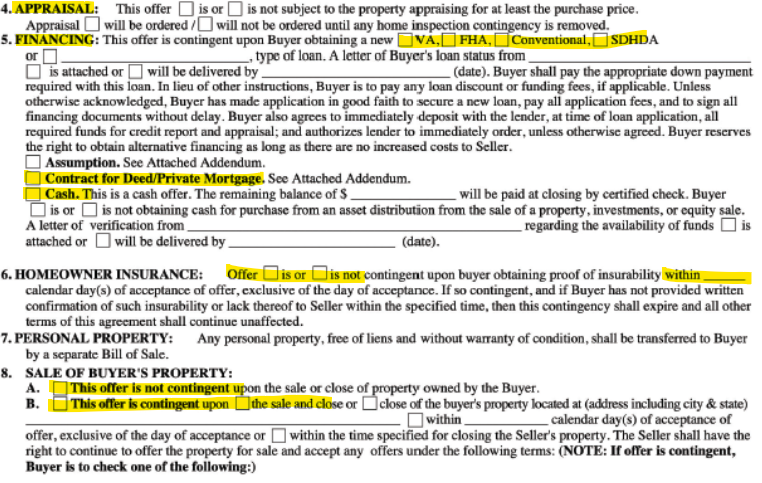
- Appraisal – An appraisal, as mentioned in previous posts in this series, is an inspection by an Appraiser, whose job it is to provide an opinion of the value of the property. The appraiser will compare other similar properties to the property you are trying to purchase and verify this property’s value based on the combination of sale prices the other properties had (or use other valuation methods).
- On the purchase agreement, you are notating whether or not the purchase of the property is or is not dependent upon an appraisal being done AND the value coming in at the purchase price or higher.
- It does not have to do with if a mortgage program or company requires an appraisal or not. You can still have an appraisal done as part of the purchase, even if you do not make the purchase contingent on the appraisal coming in at value.
- The appraiser is also going to look at the quality of the home. Each mortgage program and lender will have different requirements on the property’s quality. If there is something on the property that the program or lender wants fixed, the appraiser will note that and require it be fixed prior to closing. With some programs, it could be as simple as repainting some exterior portions of the home.
- Why would you have your offer be not contingent upon the property definitely being worth what you are buying it for? The purchase agreement is stronger to the seller if they know you will buy the property even if it does not appraise for the price you agreed upon. So, you can often beat out other offers that do have that contingency in place. But, it is a bigger risk to you. So, unless you need to, it will be recommended you make the offer subject to the property appraising for the purchase price.
- Financing – This is where you put the information about how you will be coming up with the funds to purchase the home. There are a variety of ways, as outlined in this section, to purchase a property. Here are the options outlined.
- Mortgage Financing – most residential properties are purchased with mortgage financing. In essence, the mortgage lender will provide the funds (minus your down payment) to pay for the property, and the buyer of the home/borrower of money will pay back the mortgage over time. Though this is a common way to buy a home, it is not as strong in the seller’s eyes because the mortgage program and mortgage lender will require more steps to be completed. That could delay or cause issues with closing on the sale. “Assumption“, as the next option in the list of financing directions, also include a mortgage lender, but instead it is the lender that has the current mortgage on the property.
- Contract for Deed – this option still involves a mortgage, of sorts, but the big difference is the seller of the home is the one who lends the money to the buyer. In essence, with this type of contract, the buyer puts a down payment down that he gives the seller of the home, and pays the seller monthly payments until the home is paid off. The seller sells the property to the buyer in exchange for putting a mortgage lien on the property and an agreement in place that the buyer will pay the seller a certain amount monthly (including interest) or the seller gets to take the home back if the buyer does not make his/her payments. Most seller’s do not want to accept these offers, as they would traditionally prefer to get paid all their equity at the sale instead of receive payments over time. Plus, it is a bigger risk to the seller.
- Cash – This is as it sounds. The buyer has enough money in the bank or in other liquid accounts to pay cash for the property. This makes the transaction much cleaner and smoother, and often has the least amount of risks for the seller. So, seller’s often prefer cash offers over other directions, if there are multiple offers.
- Homeowner’s Insurance – Hopefully you know what this is already. If you have any type of financing on the home, you have to have homeowner’s insurance on the property. If you are buying with cash, you can choose whether or not you want insurance on the property (though I do not know why you wouldn’t).
- Either way, you put whether the offer is contingent upon you acquiring insurance coverage, and by when. Take this seriously. If the property turns out to be very difficult to insure (which happens more and more in today’s environment where insurance company are bleeding money), you want to know that before your time runs. So, give yourself plenty of time to find insurance quotes on the purchase agreement and get a variety of insurance quotes checked out. AND get the quotes finalized well before the date you say you will.
- Sale of the Buyer’s Property – If you have a home to sell, and you want to make the offer contingent upon you getting that home sold prior to, or simultaneous to, the close of the purchase, you would mark that in this section. You also would have to put the address of the home needing sold, and some other information.
- If you do have a home you need to sell prior to closing this purchase, your offer will look much weaker in the eyes of the seller compared to a buyer that does not have to sell their current home first. So, if you are competing against others for a property, it would be best to try to get approved to buy the new home without the contingency of needing to sell your current home. For many people that is not an option because they cannot qualify with multiple mortgages at once. If it is and option, it is worth the consideration to strengthen your offer.
Page 2

- Title – The title section describes how you are taking ownership of the property. If you are buying the property by yourself, then things are pretty easy and you just mark that you are buying as a single person. If you are buying with others, you would need to break out whether that other person is your spouse (at which point you mark married) or if they are not a spouse which direction you prefer:
- The first option is “Joint Tenants with Rights of Survivorship“. This means that if one of the buyers passes away or is incapacitated, that person’s ownership rights can/would pass to the other living individual. So, the remaining person would then be 100% owner. This works best if the other person is your significant other (but not married) or another family member. The person who passes away would not have their ownership percentage need to go through probate, etc.
- The second option is “Tenant’s in Common”. This means that if someone passes or is incapacitated, their percentage ownership (50% if two people own together) would go to their estate and the estate would be part owner of the property with the other person. This is often best if two friends buy together, or two rental property owners are buying an investment property together.
- Seller’s Disclosure – in a traditional purchase scenario, the seller of the property has to fill out what is called a Property Disclosure. This paperwork has a series of questions on it for which the seller must answer and supply to any prospective buyer of the property. It covers if the seller knows of any issues on the property, if the seller knows of any work having been done on the property, and more. You as the buyer will want to review these forms, in detail, to make sure you understand any potential issues with the property. You then would mark if the offer is contingent upon you receiving further information on anything.
- Other notes here – The seller has to be honest and forthcoming with the information. If they lie about something with the property, and it is a major issue, they can be sued by the new buyer later on.
- If the property is a new construction home, and therefore there is no history of anything with the property (as it did not exist prior to this period of time), there may not be a seller disclosure required.
- Inspection of Physical Condition – or in other words, a home inspection. You have the right to a home inspection on the home no matter what, but in the purchase agreement you would mark whether or not you are going to make buying the home contingent upon getting and reviewed a home inspection within a certain amount of time.
- If you make it contingent upon a home inspection(which is traditionally going to be recommended), it does make your offer a little weaker in the seller’s eyes because it could slow down the closing process if you find any issues. Obviously, if there are issues, you want to find them, and that is the point of doing the home inspection and making the purchase of the home subject to the inspection. But, in times past, people have opted to not make the home inspection contingent in order to strengthen their offer and beat out other offers. In general, this is not recommended, but can be done.
- Make sure whatever period of time you put on the purchase agreement (for when you will have the inspection completed and information returned to the seller), you stick to it. If you mess up and don’t complete the inspection and review of the inspection in time, you could be stuck buying the home even if you found something of concern.
- Survey – Often overlooked, having the offer subject to a survey being done can often be worthwhile. A survey is just a mapping of the property boundaries and where the buildings sit on the property. But, it can often settle arguments with neighbors down the road when people are not sure where their lot lines start and end. It also protects you as the buyer so you can catch if the previous owners accidently built any structures that encroach on the neighbors land. If something does, it can be addressed during the purchase instead of finding out later and a neighbor requiring you to tear it down or move it.

PAGE 3 –
- Taxes and Prorations – This section is built in for the purpose of deciding how any outstanding costs that the property has during the year will be split up by the buyer and seller. Many properties have homeowner’s association costs, road maintenance area costs, and other costs outside the norm. Other properties may have already purchased products sitting on the property for future use, that would get taken over by the buyer (such as large propane tanks or other sources of fuel for heating, etc.). And, of course, every property has property taxes that need to be paid up. All that can be addressed here.
- Traditionally, you will see that buyer’s and sellers agree to prorate the costs for the property to the date of closing. Meaning, the seller will pay for everything (taxes, HOAs, etc.) to the day the home is sold and then the buyer will pay everything moving forward. But there can be unique situations that come up. If a unique situation comes up, you can deep dive into the different directions to go within this section. Otherwise, you will likely mark that everything will be prorated to “Closing” and any property taxes will be prorated based on the most recent county information.
- Possession and Closing – Many people don’t think about this because they usually start moving into a home on the day they close. But in certain situations, a buyer may not want to take possession of the home on the closing day. They may request to move in prior to closing, for instance. If you have a unique situation where you wish to take possession sooner or later than the closing date, you can request that in this section. For most people, you will mark possession and closing as the same day. But, of course, make sure the day you choose for closing is a day you can actually close, easily. Don’t schedule closing for days you may be on vacation or a work trip, holidays, etc.
- Seller Concessions – As a buyer, you can ask the seller to cover a certain dollar amount of your closing costs and prepaid items (taxes & insurance). Or you can base the amount of the seller concession as a percentage of the purchase price. This request is fairly common and can help the buyer out by reducing their out of pocket costs and interest rates.
- A couple things to note:
- Though it is fairly common to request concessions from the seller, it does make your offer look a little weaker. So, if you are competing against a few people to win out on a home, it is likely you would not want to request any concessions (or you would at least request less concessions) to improve your chances of winning out on the offer.
- If there is a good likelihood you can get seller concessions, make sure you review how much you can request with your mortgage loan officer. Each program will allow different amounts so you need to make sure you stay in the lines.
- A couple things to note:
- Compensation – In today’s world, the commissions paid by the seller (or buyer) need to be very visibly disclosed. This section breaks out how the buyer’s real estate agent will be paid. You would go through this with your real estate agent.
- Other Provisions – As normal, the standard legal document may not cover every scenario or need in a transaction. This section is left to open the options for other ideas, requests, or disclosures. Make sure, if you wish to address anything else (you would like to use a specific title company, you would like to detail a contingency list above, etc.) that you outline it here.
- Again, before putting in some non-traditional verbiage into the contract, it is always best to review that with your mortgage loan officer to make sure there would be no issues on the financing side.
After these sections, the final portion is signing the purchase offer, sending the offer over to the seller, and asking them to respond within a certain amount of time. Sending the offer to the seller to review can be both exciting and nerve-wracking. Just make sure you set the offer up how you are comfortable and everything should be good. Once the seller responds to your offer (by accepting it, countering it, or declining it), you get to go from there.
Hopefully this helps you understand this portion a bit more and helps make your future offers less stressful. For more details on the home buying process, see other posts and gain more insights.
Also, for an article that has nothing to do with home buying, but is non-the-less about a roof over some ones head, check out How People Stay Warm in Igloos
If you would like another article to jump start your learning on home ownership and home buying- try this one:


0 Comments