

2 Jan 2025
Post by Midwest Money Mentor
You are under contract on a home and working through the steps of getting the home inspection ordered, homeowner’s insurance quotes requested, earnest money sent to the seller, and so on. Or, you are doing a refinance and getting documents ready for underwriting review.
As expected, your loan officer let’s you know that the initial disclosures have gone out to your email. And, you need to review and sign them.
What will be in these disclosures and how do you understand what you are electronically signing?
For most traditional loan programs out there, much of the initial loan disclosures will be the same format. The government program that you are going with (FHA, VA, Conventional, Rural Development, and others) will provide you a large amount of documents that do a few different things:
- They will confirm with you that the information you submitted in the application with the mortgage lender is correct and accurate.
- They will provide you information on your rights during the process (based on the program you are going with). Most of these rights state information like you have the right to an appraisal, the right to a home inspection, the right to see your credit scores, and so on.
- They will warn you against mortgage fraud and other illegal activities.
- And they will provide you example numbers or final numbers via the “Loan Estimate” with your initial disclosures and ending numbers in the “Closing Disclosure”.
All of the information is good to go through, but most of it is generic mortgage information that everyone has to acknowledge to get a mortgage. Still, do a quick review of this information, just to make sure everything is lining up and it all makes sense to you.
Then, one of the more important aspects of the disclosures will be the numbers. This is important so you can make sure everything is adding up with what you understood in your pre-approval and the offer you made on a property. When you get either of these disclosures (Loan Estimate or Closing Disclosure), the number’s sections will look very similar. But, you should review the numbers, in detail, to make sure everything is correct.
What we are going to do here, is present the pages of an example loan estimate (for a refinance) for you to see how pieces are broken out. We are not going to go through each line because that would be a very, very long post. But, we will go through a little bit of info on each page and the page’s purpose. Once you have seen these pages, and hopefully have a better understanding of what to expect, you can use this to review your own numbers with your loan officer. And, hopefully, make sure you are getting charged what you should.
Page 1 –
At the top of the Loan Estimate, you will see your personal information, the address you are under contract on, and the purchase price. If you are doing a refinance, it will switch to showing the address of the property being refinanced and an estimated value of the property.
To the right of this basic information, you will see this grouping of pieces.
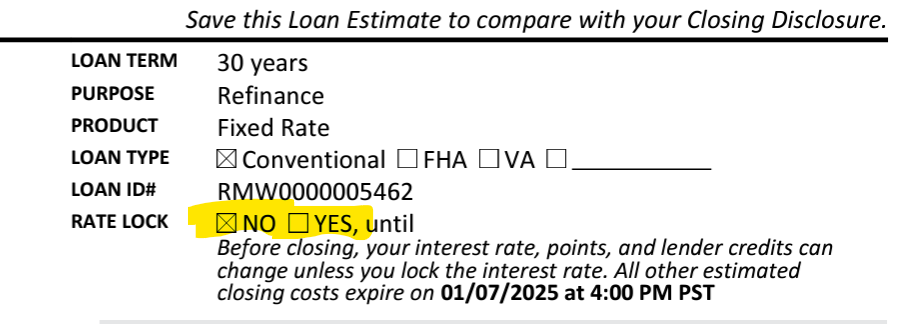
This is where you can verify the term of the loan you want to go with is correct (30 year, 20 year, 15 year, etc.), the type of loan you are doing is correct (conventional, FHA, and so on), and if the interest rate is currently locked in or not. If you requested the loan officer to lock in the rate, and you see the box marked “No” next to “Rate Lock”, make sure you follow up with the loan officer about the error.
Below this area, you will see more information broken out like this:

First, we should point out that if you are looking at the “Loan Estimate” with your initial disclosures, the key word is “Estimate”. This disclosure is simply an estimate of your costs and these numbers can (and most likely will) change. The big key is it allows you to see an approximate, up-front breakdown, of what your costs could look like. If anything big changes on the lender’s side (such as the interest rate or lender fees) the lender has to re-disclose the numbers to you again so you know of the changes and agree to them. But just know, the first disclosure is an estimate.
As you can see on the page, much of the big information (such as your locked in or estimated interest rate, your principle and interest payment, and total payment estimates including your taxes and insurance costs in your escrow payment) will be broken out. Obviously, make sure the rate you were expecting, approximate payment you were expecting, and other pieces add up to your expectations. Finally, at the bottom of the form, you should see your “Estimated Cash to Close”, which shows you your total down payment plus closing costs that you are covering out of pocket to close on the purchase or the new refinance. As you can see above, I have highlighted the section that states whether the funds are coming “from” the borrower (you) or the funds are going “To” the borrower (you). If you are doing a traditional or cash-out refinance (which is the example above) or you have negotiated excess seller credits and are not putting money down on a purchase, you could be getting money back at closing (like this example of someone taking out equity from their property to cover home improvement costs). On a normal transaction though, you will have funds you need to bring in.
Another quick note, the section that shows “Estimated Closing Costs” right above the “Estimated Cash To Close” section is likely to be confusing for you. This section (Estimated Closing Costs) will show every possible cost associated with the mortgage transaction, not just fees charged by the mortgage company. So, any mortgage insurance charged up-front by the VA or by FHA (which can be substantial at times) and rolled into your loan balance, your homeowner’s insurance premiums, property taxes in your escrow account, and other costs will be included in here. These very well may not be fees you are actually paying at closing or paying out of pocket (hence why this line can be confusing). For now, don’t focus on that line and instead review the next couple pages to make sure your fees add up correctly to what you and the loan officer talked about.
Page 2:

Page 2 provides you a line by line breakdown of the costs associated with your transaction, and helps you understand where they got the numbers on page 1, “Estimated Closing Costs”. This is an accounting type form, which can still be confusing, but does give you a better visual to go by.
There will be 10 sections broken out, as you can see.
The first section, labeled “A. Origination Costs”, on the top left, displays costs you are paying to the lender. You could see origination fees, administrative fees, service fees, underwriting fees, document preparation fees, and more, depending on the lender you work with. Make sure the fees the loan officer discussed with you seem accurate here, as these are the fees controlled by the lender.
In section A., you will also see percentage fees of the loan amount, also called “points”. Some lenders charge percentage fees instead of flat fees, and most lenders show you paying “points” or “Discount Points” to lower your mortgage rate. You should have reviewed what points are with your loan officer before the disclosures went out. If they did not review with you, make sure you understand how points work and if you actually want to pay them based on your particular scenario.
Section B. is “Services You Cannot Shop For”. As you can see, this would be appraisal fees, credit report fees, and other fees required to be paid to complete aspects of the mortgage process. Some fees can be a little different here, depending on the lender, but it is unlikely to be by much.
Section C. is “Services you Can Shop For”, and includes closing services through title companies or closing attorney’s, among other potential pieces.
Section D. just shows you a total of the costs added up in A., B., and C.
Section E. will largely be fees to complete important steps after closing, such as having the mortgage and ownership paperwork recorded with the local county/state, and any transaction taxes paid. This makes sure the person buying the property actually shows as the new owner and the new mortgage gets recorded as a lien.
Section F. will show you the “Prepaids”. Prepaids are aspects of the mortgage that get paid at the time of closing, but are sent to third parties. This could be paying the homeowner’s insurance company the insurance premiums to insure the home, or the county to pay up property taxes. If you are using a government style mortgage program (FHA, VA, Rural Development), you likely have up-front mortgage insurance that needs to be rolled into your loan balance and will be included in this section. Finally, you will also see that you have to pay “Prepaid Interest”, which is the interest you owe for the number of days you have the mortgage the month you close the loan. For example, if you close on a home purchase on the 28th of February, you will only pay one day of interest (for the 28th) because you own the home one day that month (the next day is March).
Section G. is for your escrow account. Your escrow account (if you have one) pays your homeowner’s insurance, property taxes, and other potential recurring costs for you in the future. In essence, you have to have a certain number of months of property taxes and homeowner’s insurance established in the escrow account at closing, so the lender can build up enough funds over time to pay those costs (taxes, insurance, etc.) when they come due down the road. The sooner those payments are coming due, the more money needs to be set aside in the escrow account to pay them.
Section J. shows you the total of all those pieces (origination costs, closing company costs, appraisal fees, credit reports, prepaids, escrow set up, and others). And then below that is the calculation to understand how much you bring to closing (or get back). It will show you the purchase price (if buying), what the loan amount is for the amount getting covered by the loan, the closing costs (total, including escrow, etc.), anything else being paid off at closing, and then what is left to be covered by the borrower or being cashed out and sent to the borrower at closing.
I understand there is still a lot of questions and information that was not addressed here. That is ok. The point, again, is to provide you a visual of the forms and potential numbers and columns you could see listed. Once you have this visual, and understand some of the information, you can more confidently go through this step with your loan officer to make sure everything is as you expected. Use these form examples above to review. If you want more detail on this information and other aspects of the purchase or refinance process, keep going through the home-buying focused posts. There is plenty more information to share.
And, for a cool but completely unrelated picture to end this post, see the “Christmas Tree” star grouping below.

Enjoy.


0 Comments