

19 Nov 2024
Post by Midwest Money Mentor
In recent reports by the Federal Reserves1 and by the National Association of Realtors2, there (again) showed a huge disparity between the average homeowner’s wealth in this country, compared to the average renter’s wealth.
To start, I just want you to visualize the chart below to help with understanding this information. This chart was created by those helpful souls over at MBSHighway.com
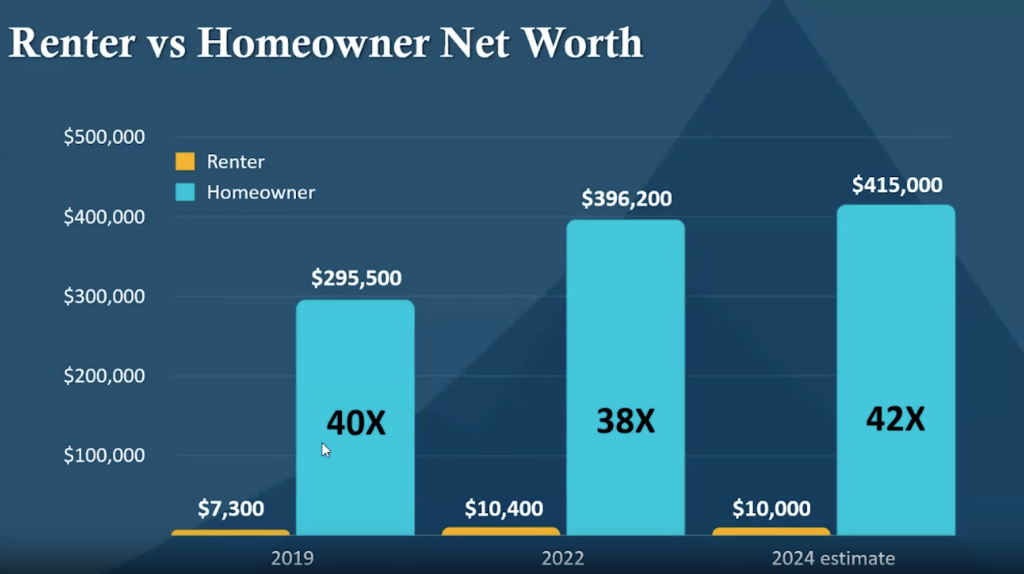
What this chart is showing is that in 2019, the average renter showed a net worth (which remember, is taking all of your assets [investments, real estate, bank accounts, etc.] and subtracting the amount of loan balances you have [car loans, student loans, credit card debt, mortgages, etc.] so you know how much actual wealth you have) of $7,300. In essence, the average person renting in the U.S., if you added up their assets, sold them, and paid off their debt, they would have around $7300 left to their name in 2019.
On the flip side, in 2019, the average person who owned a home could add up all their assets (including the home), sell them, pay off their debt (including their mortgage) and still have around $295,500.
In 2022, that amount for both renter and homeowner jumped. The renter, possibly due in part to the amount of government money that was sent out to people via stimulus checks, rose by just over $3000. The average homeowner on the other hand, had their average net worth increase by over $100,000. This, of course, heavily involved the large increase in home values during the COVID time frames. I don’t know about you, but I’d want to get the $100,000 over $3,000.
And for 2024, we only have estimates currently because the data won’t be available for a while. But, from what MBSHighway.com pulled, they show that estimates at the end of 2024 are:
- The average renter’s net worth will likely be down a little bit.
- The average homeowner’s net worth has likely increased by almost another $20,000.
All of this is to say that, one of the largest wealth creation vehicles in the United States is owning real estate. In this particular example, it is owning a home to live in.
Now, we do need to make note that there are some informational pieces that are not discussed by looking at this chart. For instance, the average renter is fairly young, traditionally. The share of renters who are under the age of 45 is 72%, according to Statisca3. So, most renters have not had as much time to accrue assets as the average homeowner. According to IPropertyManagement, the average age of a homeowner is 564, with the average age of a first-time home buyer being around 35 years old (and increasing with more recent estimates). So, it is 100% expected that the average homeowner will have a higher net worth, especially when understanding the age differences for the average person in each category, and their time available to accrue assets.
But, does that mean that age alone can explain how the estimated homeowner in 2024 has 42 times as much assets? Heck no! We need to understand that some extra assets accruing, due to age, makes sense. Retirement accounts, stock and bond holdings, business assets, and others can definitely be increased by having more time to make an income in one’s life. But, there is a large amount of dollars (40 trillion worth according to those studies) that have accrued for people who own their home. This 40 trillion, is largely due to home values having increased, fairly consistently, over time.
Is buying a home a necessity? No.
Is buying a home right now, if you do not own one, a necessity? No.
Long-term, does owning a home often increase the likelihood of accumulating more wealth? I think we are going to have to lean towards yes, based upon the Federal Reserve’s information, above.
So, keep home ownership as part of your goals and your future. It is not something every person should jump into, but if you are in a financial position to comfortably purchase and own a home, having it as one of your goals likely could make long-term financial sense. Not to mention you get to paint your bedroom pink if you so choose. Landlords may not be cool with that.
- Federal Reserve Study -PDF ↩︎
- National Association of Realtor’s Page ↩︎
- Statisca statistics on Renter Ages ↩︎
- IPropertyManagment.com Statistics ↩︎
Also, for something completely unrelated to this post, enjoy one of the “Best Science Images” of 2024 –


0 Comments