

20 Nov 2024
Post by Midwest Money Mentor
You likely hear/see financial educators or finance guru’s say things like, “Just go open a brokerage account online”, or “Make sure you own low cost Index Funds”. But, us financial educators often neglect to notice that many people don’t know how the heck to do those steps in the first place. Most American’s have not opened investment accounts, or have only used (if anything) the accounts provided to them through their employer’s retirement plan options (401k’s, 403b’s, Simple IRA’s, and so on). So, going off on their own to open their own accounts, on a website or platform they have never used or seen, can seem a little daunting and quite confusing.
This blog post is here to provide a step by step guide so you do not have to do anything on your own. You can, literally, just follow the steps in these blog posts and not worry about trying to navigate the unknown (likely for multiple wasted hours). Just read on, go one step at a time, and use the time you save to do something more enjoyable than frustratingly trying to understand new technology. Just for the record, I hate trying to figure out new technology. I am under the age group of a millennial, but I am an old man at heart and my patience for figuring out technology is measured in nanoseconds.
In this first part of the series, we are going to go through the basic steps to set up a log-in on Fidelity’s website, and then open what is called a “Brokerage” account. We will also go through, quickly, what the other account options are that you can open to make sure you have a basic understanding of these different types. This post is going to be very short and very basic because you will largely just be filling out your own information on Fidelity’s page to start your account. This way we can get you started and then on to the important pieces of choosing your investments and starting contributions (which ultimately is what leads you to financial freedom). Check out the basics below, quickly create your account (don’t worry if you don’t do it perfectly, you can change things later), and move on to part 2 of the series for the real details.
A Brokerage account is the most basic investment account you can establish (at least, in my opinion). It allows you to “trade”, which just means buy and sell, Mutual Funds, ETFs, Stocks, Bonds, CD’s, and more through Fidelity’s website. The reason we start with this account type on this post is that your investments are liquid in this account. So, if you needed to take the funds back out for some reason (which you need to plan on NOT taking them back out unless absolutely necessary), you can do so, without penalty.
Quick note with brokerage accounts, any returns you receive through dividends, interest, and capital gains (if you sold funds), are taxable. So, this is a great account to open to begin investing on the platform, but depending on your goals and financial situation, you may want to focus more heavily on a more tax favorable account (IRA, ROTH IRA, or others) down the road.
If you have already set up an account and want to jump more into how to purchase funds, see the second part of this series on how to buy low cost mutual funds.
For everyone that is beginning, let’s start by going to Fidelity’s website – https://www.fidelity.com/.
When you are on the website’s home page, you will see right, smack-dab, in front of you, a button to open an account. It is almost like they want to make it easy to take your money?
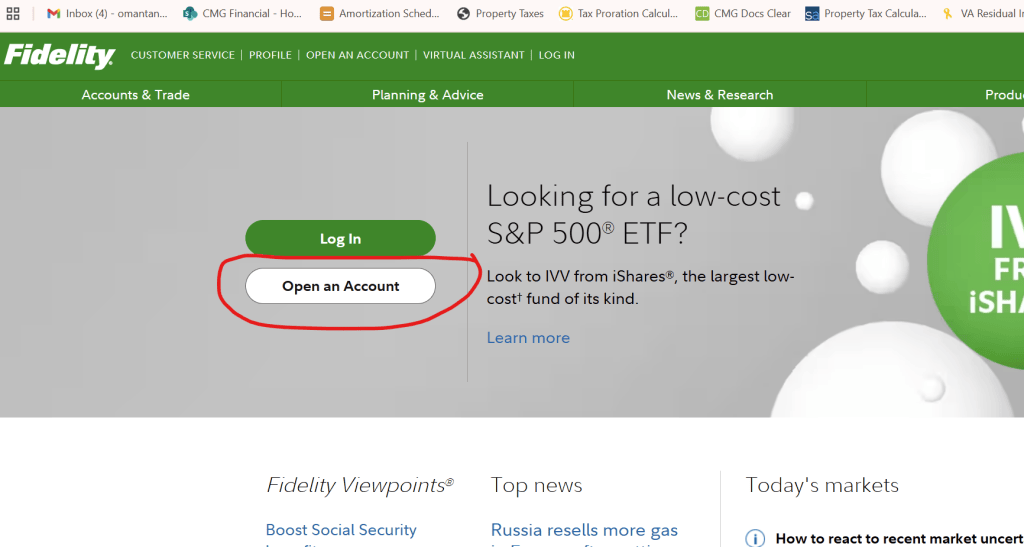
Once you click on that button, you will be provided a series of options on which account type you wish to open. Here is a quick peek.
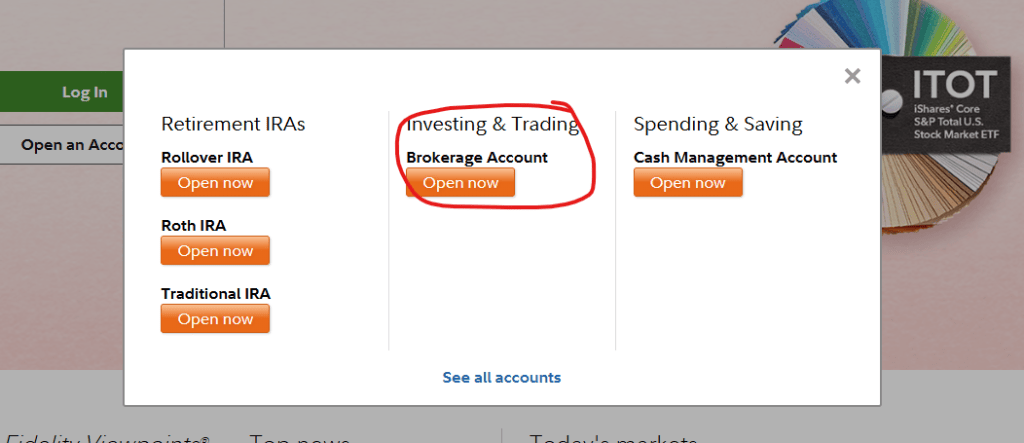
As I mentioned above, we are going to focus on opening a brokerage account, which I circled in the picture. But, lets do a quick overview of the other account types listed.
- Rollover IRA (Individual Retirement Account) – A Rollover IRA is simply an account that you establish so you can transfer money from another retirement account to you own individual retirement account, without tax consequences. Traditionally, you would be moving money from a 401k, 403b, 457, TSP or Simple IRA, that you had as a retirement account through a previous employer. Or you can rollover another existing IRA (or Roth IRA). If you are in a position where you have unused accounts sitting out in the world from old employers or old inheritances. This would be a good account to set up so you can move that old money over and begin expanding those investments again. Again, it is for transferring tax deferred retirement accounts over to another retirement account, so you do not have a tax burden.
- Roth IRA – This button would have you open a new Roth IRA. A Roth IRA is another individual retirement account (that you cannot take money out of until age 59 1/2, without penalty) that you can put money into to invest in mutual funds, ETFs, and other investment types, after you already paid taxes from your income out of your paycheck. The money in this account (including gains, dividends, and interest) would not be subject to taxes again down the road (as long as you follow the rules). This is a good account to use for your long-term investing strategy, in particular if you are in a lower income tax bracket, currently. We will review Roth IRA’s in greater detail in other posts.
- Traditional IRA – the traditional individual retirement account button just would mean you would be opening a new retirement account that is not a Roth designated account. These accounts allow you to deduct the amounts you put into this account from your taxable income on the year you deposit the funds into the account. So, in essence, you pay less income tax that year because you invested the money. On the flip side, since you are taking your tax break up front with this account, when you do withdraw the funds later in life, the money is then taxable at that point. Just like with any retirement account, if you take funds out of the account (except under special circumstances) prior to 59 1/2 years old, you can be penalized.
- Cash Management Account – this is as it sounds. You can set up the equivalent of a bank account or other cash account with Fidelity to use Fidelity as your bank or a bank equivalent.
After you click to open the brokerage account, you will see this page pop up.

We will be assuming you are not a Fidelity customer, so click no. If you are already a Fidelity customer, then sign in and jump to the next post about buying low cost funds.
From here, go through the Fidelity pages that ask about your personal information, if you want to set up a single person or joint account, and more. I won’t walk you through these pieces as you, hopefully, know your information already. Once you complete the account set up, jump on to the 2nd blog post where we go into detail while on the website an in your account.


0 Comments